

 Company Profiles
 Company Culture
 Message
 Honor
Honor Video Center
 Company Reality
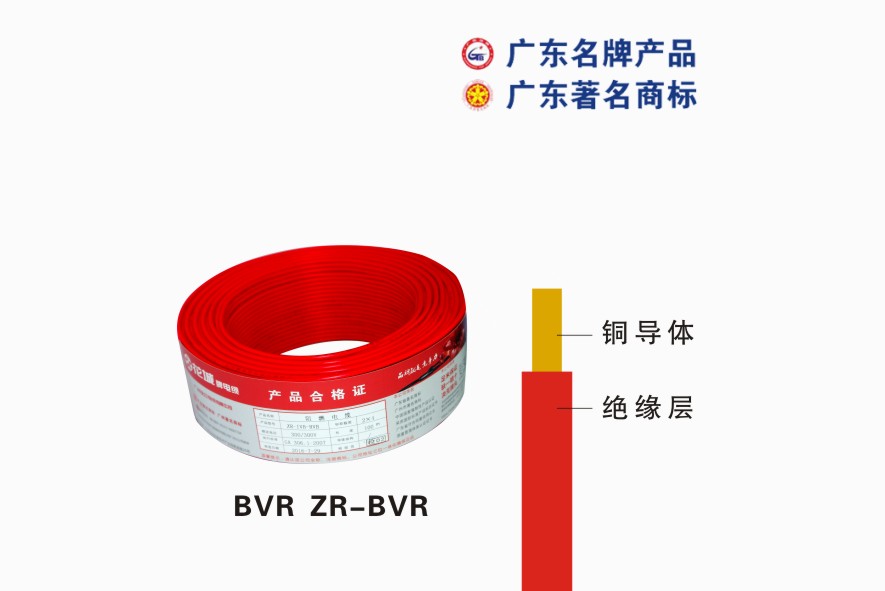 Pearl River Cable
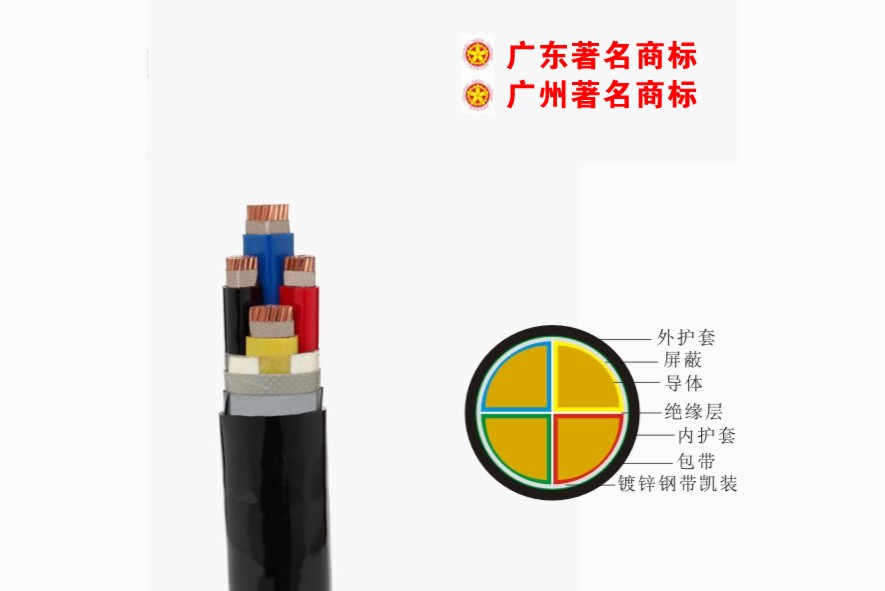 Low Voltage Cable
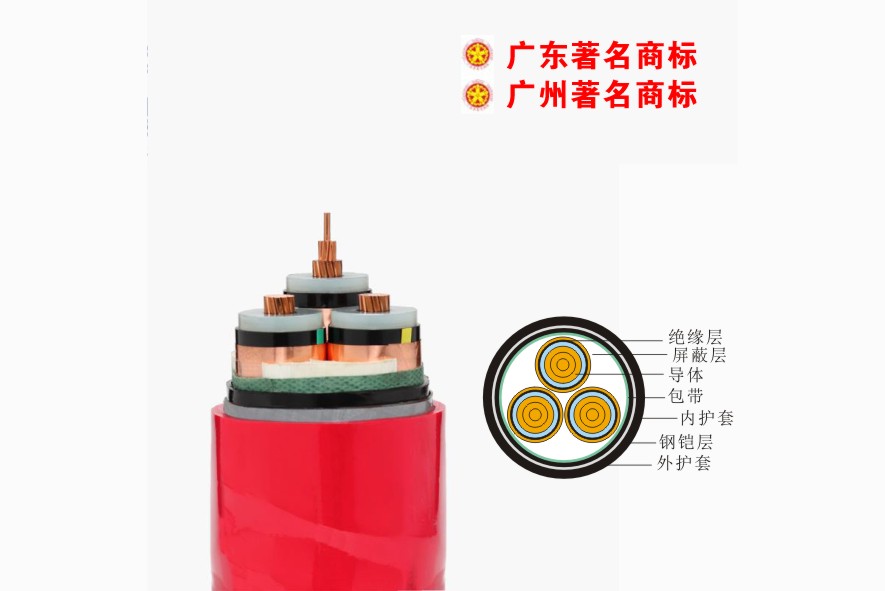 Medium Voltage
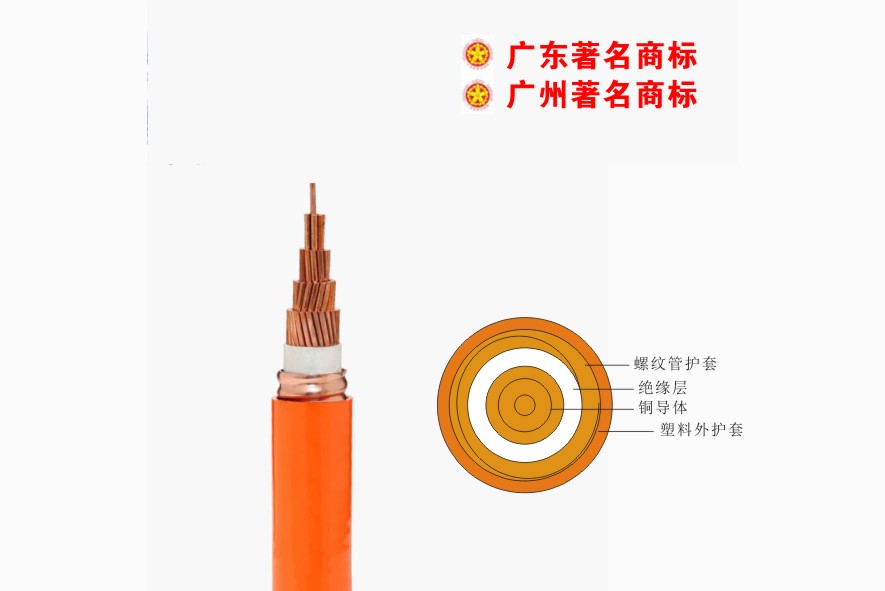 Mineral Cable
 Control Signal Cable
 Corporate News
 Cable Information
 Media Reports
 Network Reprint
Multiple understanding methods of cable current carrying capacity
Multiple understanding methods of cable current carrying capacity
We know that the current carrying capacity of a wire is related to the cross section of the wire, and also related to the material, model, laying method, and ambient temperature of the wire. There are many influencing factors and the calculation is more complicated.
The current carrying capacity of various wires can usually be found in the manual. But using formulas and some simple mental arithmetic, it can be calculated directly without having to look up the table.
1. Select through the cable ampacity meter
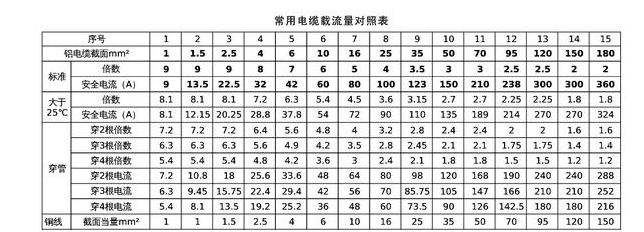
2. the calculation formula of the current carrying capacity of the conductor
1. Formula: The relationship between the current carrying capacity of the aluminum core insulated wire and the multiple of the cross section
10 under five, 100 on two;
25, 35, four and three realms;
70, 95, twice and a half;
20% off for tube and temperature;
Bare wire plus half;
The copper wire upgrade counts.
2. Explanation The formula does not directly indicate the current carrying capacity (A) of various cross-sections, but is expressed by multiplying the cross-section by a certain multiple. To this end, the nominal cross-sections (square millimeters) of commonly used wires in my country are arranged as follows:
1, 1.5, 2.5, 4, 6, 10, 16, 25, 35, 50, 70, 95, 120, 150, 185...
(1) The first sentence of the formula points out that the current carrying capacity (A) of the aluminum core insulated wire can be calculated as a multiple of the cross section. The Arabic numerals in the formula indicate the cross-section of the wire (square millimeters), and the Chinese numerals indicate multiples. Arrange the cross-section and multiple relationship of the formula as follows:
For wires of 1.5, 2.5, 4, 6, 10mm2, the cross-sectional area can be multiplied by 5 times.
For wires of 16, 25mm2, the cross-sectional area can be multiplied by 4 times.
For wires of 35 and 50mm2, the cross-sectional area can be multiplied by 3 times.
For wires of 70 and 95mm2, the cross-sectional area can be multiplied by 2.5 times.
For wires of 120, 150, and 185mm2, the cross-sectional area can be doubled.
Now it is clearer to compare with the formula. The formula "10 under five" means that the wire cross section is below 10, and the current carrying capacity of the wire is five times the value of the cross section. "100 on two" (read one hundred on two) means that the current carrying capacity of a wire with a cross section of 100 or more is twice the value of the wire cross section. The cross-section of the wire is 25 and 35, which is the boundary of four times and three times. This is the mantra "25, 35, Four and Three Realms". The cross-sections of wires 70 and 95 are 2.5 times. It can be seen from the above arrangement: Except for wires below 10 and wires above 100, the cross-section of the wires in the middle is a multiple of the same for every two specifications.
For example, the calculation of the current carrying capacity of the aluminum core insulated wire when the ambient temperature is not greater than 25°C:
When the wire section is 6 square millimeters, the calculated current carrying capacity is 30 amps;
When the wire section is 150 square millimeters, the calculated current carrying capacity is 300 amps;
When the cross section of the wire is 70 square millimeters, the calculated current carrying capacity is 175 amps;
It can also be seen from the above arrangement that the multiple decreases with the increase of the cross-section, and the error is slightly larger at the junction of multiple transitions. For example, the cross-section of wire 25 and 35 is the boundary between four times and three times. Wire 25 belongs to the quadruple range. According to the formula, it is calculated as 100 amps, but according to the manual, it is 97 amps. On the contrary, 35 is the opposite, which is calculated as 105 amps according to the formula. , But the check-up is 117 amps. But this has little effect on usage. Of course, if you can "know the number in your chest", when choosing the cross section of the conductive wire, it is more accurate to not let it be full of 100 amperes for 25, and slightly more than 105 amperes for 35. Similarly, the 2.5 square millimeter conductive wire is located at the beginning of five times, which is actually more than five times (the maximum can reach more than 20 amperes). However, in order to reduce the power loss in the wire, usually the current does not need to be so large. Standard 12 amp.
(2) The following three sentences are the handling of conditional changes. "Through pipe, temperature, 80% or 10% discount" means: if the wires are laid through pipes (including laying of grooved plates, that is, the wires are covered with protective sheaths and are not exposed), after calculation, they will be discounted by 20%; if the ambient temperature If the temperature exceeds 25°C, a 10% discount will be given after the calculation. If the temperature exceeds 25°C, it will be 20% off and then 10% off, or a simple 30% discount will be calculated once.
Regarding the ambient temperature, according to the regulations, it refers to the average maximum temperature of the hottest month in summer. In fact, the temperature fluctuates. Under normal circumstances, it does not affect the current carrying capacity of the wire very much. Therefore, discounts are only considered when the temperature exceeds 25°C in certain greenhouses or hotter areas.
For example, the calculation of the download flow of aluminum core insulated wires under different conditions:
When the cross-section is 10 square millimeters, the current carrying capacity of the wire is 10×5×0.8=40A; if it is high temperature, the current carrying capacity of the wire is 10×5×0.9=45A; if it is high temperature through the pipe, then The current carrying capacity of the wire is 10×5×0.7=35A.
(3) For the current carrying capacity of bare aluminum wires, the formula points out that "the bare wires are added by half", that is, add half after calculation. This means that the current carrying capacity of the wire can be increased by half compared with the aluminum core insulated wire of the same cross-section bare aluminum wire.
For example, the calculation of the current carrying capacity of bare aluminum wires:
When the cross-section is 16 square millimeters, the current-carrying capacity is 16×4×1.5=96 amperes, and if it is at high temperature, the current-carrying capacity is 16×4×1.5×0.9=86.4 amperes.
(4) Regarding the current carrying capacity of copper wires, the formula points out "Copper wire upgrade calculation", that is, the order of the cross-section of the copper wires is increased by one level, and then calculated according to the corresponding aluminum wire conditions.
For example, the ambient temperature of a bare copper wire with a cross section of 35 square millimeters is 25°C, and the current carrying capacity is calculated as follows: 50×3×1.5=225A by upgrading to a bare aluminum wire of 50 square millimeters.
For cables, there is no introduction in the formula. Generally, for high-voltage cables directly buried in the ground, the relevant multiples in the first sentence can be directly used for calculation. For example, the current carrying capacity of a 35 square millimeter high-voltage armored aluminum core cable buried in the ground is 35×3=105A. The wire and cable of 95 square millimeters is about 95×2.5≈238A.
3.the formula for estimating the current-carrying capacity of cables
Multiply 2.5 by nine and go up and minus one.
Thirty-five times three and five, both in groups minus five.
The conditions are changed and the conversion is added, and the high temperature 10% copper upgrade.
The number of piercing pipes is two, three, four, and eight or seventy-six percent is full.
1. Explain that the formula in this section does not directly indicate the current carrying capacity (safe current) of various insulated wires (rubber and plastic insulated wires), but "cross-section multiplied by a certain multiple", which is obtained through mental calculation. It can be seen from the table that the multiple decreases with the increase of the cross section.
2. "2.5 times down by nine, goes up and down by one," refers to various cross-section aluminum core insulated wires of 2.5mm’ and below, and its current carrying capacity is about 9 times the number of cross-sections. For example, a 2.5mm wire, the current carrying capacity is 2.5×9=22.5(A). The multiple relationship between the current-carrying capacity of 4mm and above wires and the number of cross-sections is along the line number, and the multiples are successively reduced by 1, namely 4×8, 6×7, 10×6, 16×5, 25×4.
In addition, if you remember the copper wire of less than 6 square millimeters in the room, it is safe that the current per square does not exceed 10A. From this perspective, you can choose 1.5 square copper wire or 2.5 square aluminum wire.
Within 10 meters, the wire current density is 6A/square millimeter, 10-50 meters, 3A/square millimeter, 50-200 meters, 2A/square millimeter, and above 500 meters, it should be less than 1A/square millimeter. From this perspective, if it is not very far away, you can choose 4 square copper wire or 6 square aluminum wire.
If the power supply is really 150 meters away (not to mention whether it is a tall building), 4 square copper wires must be used.
The impedance of a wire is proportional to its length and inversely proportional to its wire diameter. Please pay special attention to the wire material and diameter of the input and output wires when using the power supply. To prevent accidents caused by excessive current and overheating of the wires.
3. "Thirty-five times 3.5, doubles in groups minus five", it is said that the current carrying capacity of 35mm wire is 3.5 times the number of cross-sections, that is, 35×3.5=122.5(A). From the wire of 50mm and above, the multiple relationship between the current-carrying capacity and the number of cross-sections becomes a group of two wire numbers, and the multiples are successively reduced by 0.5. That is, the current-carrying capacity of 50mm and 70mm wires is 3 times the number of cross-sections; the current-carrying capacity of 95, 120mm" wires is 2.5 times the number of cross-sectional areas, and so on.
4. "Conditions change, plus conversion, high temperature 10% copper upgrade". The above formula is determined by the aluminum core insulated wire and the open coating at an ambient temperature of 25°C. If the aluminum core insulated wire is exposed to the area where the ambient temperature is higher than 25℃ for a long time, the current carrying capacity of the wire can be calculated according to the above formula calculation method, and then a 10% discount is enough; when the copper core insulated wire is not used, Its current-carrying capacity is slightly larger than that of the aluminum wire of the same specification. According to the above formula method, the current-carrying capacity of one wire larger than that of the aluminum wire can be calculated. For example, 2.5 square millimeters of copper core wire is equal to 4 square millimeters of aluminum core wire, 4 square millimeters of copper core wire is equal to 6 square millimeters of aluminum core wire, and 6 square millimeters of copper core wire is equal to 10 square millimeters of aluminum core wire.
The cross section of the zero line in the three-phase four-wire wire and cable is usually selected to be about 1/2 of the cross section of the phase line. Of course, it should not be less than the minimum section allowed by the mechanical strength requirements. In a single-phase line, since the load current passed by the neutral line and the phase line are the same, the cross section of the neutral line should be the same as the cross section of the phase line.
4.choose according to the formula
1. For aluminum wire, the cross-sectional area S is equal to the power P divided by 3.5 times 220, that is: S=P/3.5X220
2. For copper wire, the cross-sectional area S is equal to the power P divided by 5 times 220 volts, that is: S=P/5X220
Example: How much square aluminum wire or copper wire is used for the power of kilowatt (KW)?
solution:
Aluminum wire=1000/3.5X220=1000/770=1.298 square millimeter. Choose 1.5 square aluminum wire.
Copper wire=1000/5X220=1000/1100=0.9 square millimeter. Choose 1 square copper wire.
5.choose the wire according to the current density
J=I/S,
Where:
S----Wire cross-sectional area (square millimeter)
I------current (ampere)
J-----current density (A/mm2)
The allowable current of 1 square millimeter of copper wire is 6A,
The allowable current of 2.5 square millimeter copper wire is 15A,
The allowable current of 120 square millimeter copper wire is 280A.
Example: a certain lighting
The current of the circuit is 21A,
Ask how thick copper wire should be used?
Solution: S=I/J=21/6=3.5 square millimeter copper wire, because the commonly used wire does not have a 3.5 square millimeter wire, so choose a 4 square copper wire.
In addition, lines below 10 squares are 6 squares X6, 4 squares X7, 2.5 squares X8, 1.5 squares X9, and 1 squares X10.